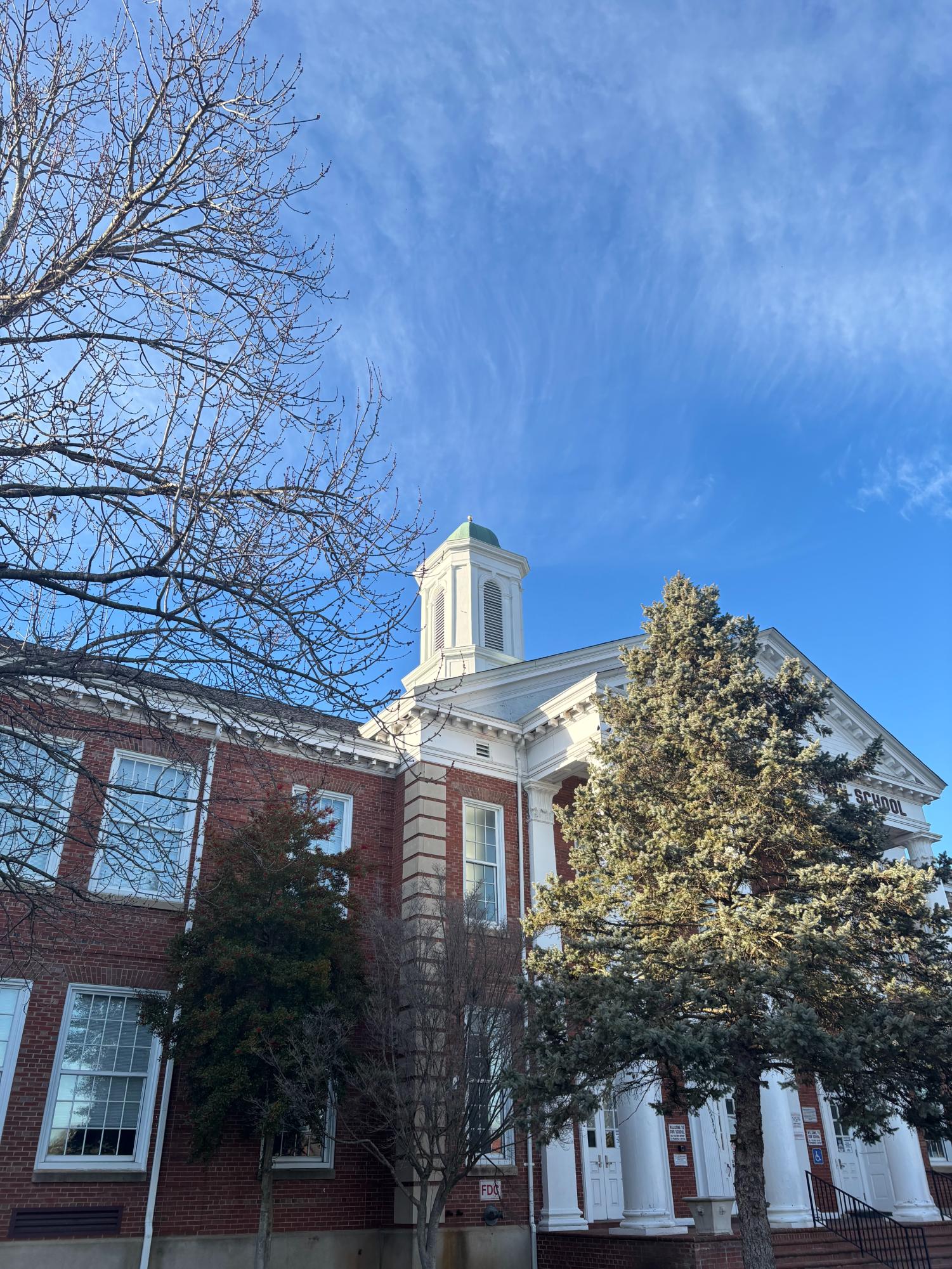
In the early morning flurries, a soft winter’s light reaches across the city of Bristol, Tennessee. With this crisp illumination, the outline of a wooden tower topped with a bronze glow becomes visible from all across the city.
This feature, a defining characteristic of the city’s skyline, is the cupola at the front of Tennessee High School.
Over the past few months, this piece of Bristol history underwent extensive restoration efforts. This work involved improving the structural stability and appearance of the historic tower.
Through the years prior, the 1939 structure had seen considerable deterioration. This natural wear on the tower was characterized by peeling paint and rotting wood.
Led by the Bristol Tennessee City School District, the restoration started as work on the roof of the main building. In this process, efforts were expanded to the cupola itself.
Curt Rutherford, the Chief Facilities and Maintenance Officer for the school district, helped pilot the direction of maintenance to the tower.
“We thought it was logical to repair the mill work and some of the wood that had rotted on the cupola,” Rutherford said.
These trim and board replacements were completed with consideration for the history and significance of the structure with the intention to stay true to the origin of the school.
“We really try to make an effort to match up architectural products that look similar to the original design [and] original intent,” Rutherford said.
While completing this work, a discovery at the highest point opened the door for additional efforts to restore the tower further.
“I had known for some time that the original plans [showed] a finial ball on top of the cupola,” Rutherford said. “I was never really sure if it was missing, or maybe it [had not] been built that way originally. But, [upon examining] the cupola, we did see evidence on the top that there was […] a hole.”
Using the original 1936 blueprints, Rutherford began searching for ways to recreate the finial. A company from Missouri was inevitably tasked with constructing the ball by hand. Once complete, it was installed, finishing the cupola that had been incomplete for years.
“We had to do something to repair the hole, and to be able to put it back the way that it was originally drawn,” Rutherford said, “I think, was just the right way to do it.”
This restoration is an effort that goes beyond a direct visual and structural benefit to the school, but also to the city of Bristol. By improving the look of the landmark, the community comes to experience its positive effects.
English teacher Charlie Tiller has developed his own perspective on the significance of the completed work when viewed from a wider perspective.
“I think that [it] is really striking because our school is such a centerpiece of the town,” Tiller said.
This restoration, however, is deeper than the assurance that the cupola will stand for decades to come. It acts as a confirmation that this iconic piece of architecture and history will be preserved for the future in local education.
The tower has come to stand as a symbol for the school and the city of Bristol. As a symbol, its presence has come to make an impact in the community.
Principal Kim Kirk expresses an agreement with the importance of the structure and its symbolism.
“The cupola is certainly a symbol that helps define our traditions,” Kirk said.
The restoration process proves to be opposite than the general trend for symbols like this across the U.S. since the second World War. Generally, a move for more modern architecture and conveniences can be noted in the American mindset.
With this, many historic and traditional buildings have been renovated or completely demolished to meet modern standards. Tennessee High, however, has remained as a testament to the legacy of local education.
In reflection of the school, Tiller expresses an appreciation for traditional approaches and the resulting uniqueness.
“I think that the traditional things [are] traditional for a reason,” Tiller said.
In addition, the return of the finial comes to serve as reflection of the dedication of the school district to preserve the historic image of the school.
Astraia Kudela, a senior at Tennessee High, has seen the deterioration and following restoration of the tower and understands the image that comes from the work.
“Our school has been here a long time,” Kudela said. “So that restoration will show that we care and are trying to take care of the school.”
By putting in the effort to repair the cupola, the district shows a commitment to the history of the school and the students and alumni who have walked its halls. Through the past eighty-seven years, the cupola has stood over the city and has been a spectator to the educational journeys of thousands of students.
For the current students and staff of the school, the tower is a daily sight that is combined with many other historic structures to form the campus of Tennessee High School. These structures are unique and serve as some of the primary defining features of the school.
These traits, when compared with other high schools, reflect a great sense of tradition and dedication to the character and legacy of the school.
“We take things like [the campus] for granted because we see them every day,” Tiller said.

![Lucy Millwood [left] and Sophia Streetman [right] with water guns in hand, getting prepared to eliminate their target(s).](https://thsmaroonandwhite.org/wp-content/uploads/2026/05/senior-a.jpg)