




















![Lucy Millwood [left] and Sophia Streetman [right] with water guns in hand, getting prepared to eliminate their target(s).](https://thsmaroonandwhite.org/wp-content/uploads/2026/05/senior-a.jpg)






























175 years ago, as the nation was on the brink of sectional collapse, an accidental president sought to save the Union without one drop of blood. For a while, it seemed that he had succeeded.
Born in a New York log cabin in 1800, Millard Fillmore was the second of eight children. His family lacked the financial means to provide their children with formal schooling, He spent his childhood in privation, and, as the eldest son, he performed hard, manual labor to help his family endure severe poverty.
Fillmore’s father, Nathaniel, hoped that his son would become successful in a trade, so he prevented him from enlisting in the War of 1812. Millard was sent to a mill in Niles, New York. While there, he was determined to better himself, and he bought a share in a library in order to read everything he could.
He used his time off to enroll himself in school, and while there, he met and fell in love with Abigail Powers. Powers was instrumental in educating the knowledge-deprived Fillmore, helping him be admitted to the bar in 1823. They married in 1826, and had two children. Fillmore became the only resident lawyer in East Aurora, a town close to Buffalo.
As a young Buffalo lawyer, Fillmore became interested in politics, and he joined the Anti-Masonic Party, one of the parties that opposed the presidency of Andrew Jackson. It was at this time that he met New York political boss Thurlow Weed. Weed was impressed with the young Fillmroe, helping him be elected to the New York State Assembly 1828.
In 1832, Fillmore successfully ran for the House of Representatives. At the same time, the anti-Jacksonian forces coalesced into the Whig Party. Weed became a leader of the state party, and his friend, William Seward became his preferred politician. The Seward-Weed alliance would last for the rest of the men’s lives.
Despite being defeated for reelection in 1834, he became Seward’s top rival for state party control. He returned to Congress after the 1836 election, and nearly became speaker in 1841. As a consolation, he was appointed as the chairman of the powerful Ways and Means Committee.
He helped engineer the Tariff of 1842, which sought to better protect the country’s manufacturing interests. He was praised for the bill, but declined to seek reelection in 1842. He sought the Whig vice presidential nomination in 1844, but lost the nomination to Theodore Frelinghuysen. Instead, he was nominated for Governor, but narrowly lost to Democrat Silas Wright.
Seeking to rehabilitate his political career, he was elected state comptroller in 1847, becoming the first individual to be elected to the position. The following year, he was nominated for vice president alongside General Zachary Taylor, defeating the ambitions of Seward, who was also a candidate for the nomination.
Taylor and Fillmore were elected in November. President-elect Taylor initially sought Fillmore’s advice, as he mistakenly believed that the vice president was a member of the cabinet, which it was not at the time. But soon after, however, allies of Weed and Seward wrestled control of New York federal jobs behind the vice president-elect’s back.
The deal ruined Fillmore’s reputation in the state, and with the vice presidency lacking in responsibility at the time, he placed much of his attention on rehabilitating his image. Despite his overall lack of enjoyment of the office, he was able to put his love for learning to use as he became deeply involved in the administration of the Smithsonian Institution.
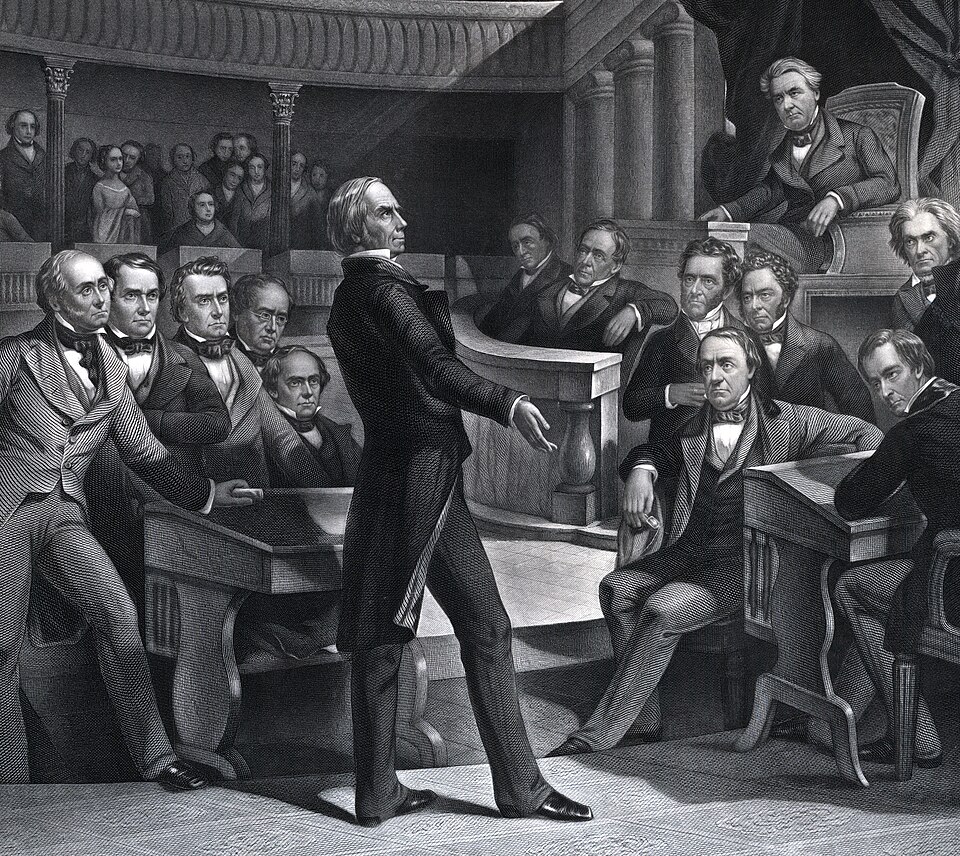
As president of the Senate, Fillmore oversaw the biggest political debate of the era: the status of slavery in the territories won in the Mexican-American War. The Taylor Administration favored immediate statehood for the territories in order to avoid the conflict that comes with slavery under territorial government. Senator Henry Clay of Kentucky led the effort in proposing a comprehensive compromise to settle the issue.
Taylor suddenly died on July 9, 1850, leaving Fillmore with the presidency. In an unprecedented move, Fillmore accepted the resignations of Taylor’s whole cabinet. He remains the only president who took over for his deceased predecessor to immediately replace the whole cabinet.
Fillmore opposed Clay’s strategy of passing one single bill to resolve the slavery issue, and he influenced the bill’s defeat soon after taking office. Clay withdrew from the Senate, and Democrat Stephen A. Douglas of Illinois became the new floor leader. Douglas proposed passing multiple individual bills to settle the issue, and Fillmore was more friendly to this concept.
A key component of the debate was Texas’s land claims over parts of New Mexico Territory. When armed Texans sought to take over their claimed lands, Fillmore used federal troops to protect the territory. The forceful response led Texas’s Senators to support Douglas’s legislation, and the Compromise of 1850 was passed and signed into law.
Citizens on the streets of Washington were euphoric, and many journalists declared the compromise to be a permanent solution to the slavery concept. Fillmore was hailed as a savior of the Union.
Despite the initial praise, sectionalism quickly rose once more. Northerners were aghast at the Fugitive Slave Act, which required that slaves who escaped to the North be returned to the South. It also required citizens to aid in the capture of fugitive slaves.
Southerners believed that making California a free state was an attempt to curb their influence in the Senate, and they also opposed the abolition of slavery in Washington D.C.
By signing the act, Fillmore opened himself up to attacks from all sides of the political spectrum, and he expressed reluctance to run for reelection as he understood his unpopularity. The 1850 midterms saw losses for Fillmore’s Whigs.
In the period before the 1852 election, Fillmore focused heavily on foreign affairs. His secretary of state was the respected statesman Daniel Webster, and Fillmore was known to spend considerable time looking over his shoulder and directing policy.
He took a particular interest in Japanese affairs, authorizing the Perry Expedition to influence Japan to open up trade relations. Although Perry did not make it until after Fillmore left office, the trip was instrumental in changing the trajectory of Japanese foreign policy.
Additionally, Fillmore and Webster stood against France’s attempts to annex Hawaii. The administration made a secret agreement with the Hawaiian king stating that the U.S. would protect the islands if attacked. Some were calling for the annexation of Hawaii as a state, but Fillmore hesitated due to his refusal to consider non-white Hawaiians citizens.
In Utah, he sought to settle the Mormon controversy by appointing Brigham Young as governor. He intended for Mormons to have increased autonomy and religious freedom instead of being micromanaged by the federal government.
As the election of 1852 approached, Fillmore was unsure if he wanted to run for reelection or not. Webster launched a campaign in 1851, and while Fillmore was sympathetic to his ambitions, the president’s Southern supporters would not accept Webster as the Whig nominee.
Commanding General Winfield Scott was the candidate of the Northern, more anti-slavery Whigs and was closely allied with William Seward. Fillmore and Webster supporters both wanted to block Scott’s nomination, but they were unable to reach an agreement at the convention, and Scott was narrowly nominated. Democratic nominee Franklin Pierce easily defeated Scott in the general election and succeeded Fillmore on March 4, 1853.
After leaving office, Fillmore planned to go on a tour of the South. At Pierce’s inauguration, however, Abigail caught a fatal illness and died on March 30. His daughter died the following year, adding to the tragedy.
Fillmore returned to politics during debates over the Kansas-Nebraska Act of 1854, seeking to build a coalition of disaffected pro-Union Whigs for the 1856 election. Seeking to avoid commenting on the controversial issues of the day, he took a year-long trip across Europe and the Middle East. Queen Victoria called him “the handsomest man [she] had ever seen.” He also met with Pope Pius XI and activist Dorothea Dix.
His allies nominated him as the Whig candidate in the 1856 election, but the party had all but collapsed at the end of his presidency. Many old Northern Whigs joined the new Republican Party, and former Southern Whigs joined the Democrats or stopped voting. Fillmore finished in third, winning just the state of Maryland.
After his defeat, he considered his political career to be over. He married Carolina McIntosh, a wealthy widow, and they became avid philanthropists. In 1860, he voted for the Democratic candidate, Stephen Douglas, but he supported the Union effort in the Civil War. In 1864, he delivered a speech opposing the Lincoln Administration’s handling of the war. Lincoln’s associates made it clear to Fillmore that such conduct was unacceptable in an election year. He voted for Lincoln’s opponent, George McClellan, in that election.
After Lincoln’s 1865 assassination, Fillmore’s house was vandalized by angry citizens because it lacked black mourning drapes. The people believed he was disrespecting the late president; in reality, Fillmore and his wife were out of town. He later expressed support for the Reconstruction policies of President Andrew Johnson.
Fillmore’s health declined in the 1870s, and he suffered multiple strokes in 1874. The second one killed him on March 8, at the age of 74. He was interred at Forest Lawn Cemetery in Buffalo.
Presidential historians are often highly critical of Fillmore. They view the Compromise of 1850, particularly the Fugitive Slave Act, as a key cause of the Civil War. Fillmore is criticized for not continuing the semi-free soil policies of the Taylor Administration.
When he signed the Compromise, it was believed that the issue of slavery was permanently and peacefully resolved. In reality, it likely only delayed the war that killed 620,000 Americans by a few years.